Jonathan
A Prince of Israel
Son of Saul and heir to the throne, Jonathan is portrayed as a courageous, capable and faithful friend whose bond with David transcended personal ambition.
Discover the history, traditions, ceremonies and principles of the Order of the Secret Monitor and its continuing story in India.
The Order of the Secret Monitor is a distinctive Masonic Order whose traditions centre upon the enduring friendship of David and Jonathan.
Its purpose is to give practical expression to the Masonic principle of Brotherly Love, encouraging members not merely to value friendship as an ideal but to demonstrate it through loyalty, care, counsel and support.
The Order is non-denominational and is open to members of a Regular Craft Constitution. Its ceremonies seek to deepen the understanding of Brotherly Love and encourage a meaningful commitment to that principle.
The history of the Order reaches back through several centuries and reflects the continuing development of the Secret Monitor tradition.
Historical and anecdotal evidence records the Secret Monitor Degree being worked in Continental Europe, North America and elsewhere.
On 13 May 1868, a Secret Monitor ceremony was conducted in King Solomon's Quarries at Jerusalem by Bro. Robert Morris with Masonic companions.
The Order was regularly constituted in London. The ceremonies were developed into a more comprehensive system centred on Brotherly Love.
Damon and Pythias Conclave No. 14, Madras, became the first Secret Monitor Conclave established in India.
The growth of the Order in India led to the formation of a District Grand Conclave of Southern India.
After more than 125 years of development in India, a sovereign Grand Conclave in India was constituted and consecrated in Chennai.
The enduring friendship between David and Jonathan forms the central inspiration of the Order.
Son of Saul and heir to the throne, Jonathan is portrayed as a courageous, capable and faithful friend whose bond with David transcended personal ambition.
David's journey from shepherd to king forms an important part of the biblical story on which the ceremonies of the Order are based.
The Order places particular emphasis on the practical expression of Brotherly Love.
A distinctive feature of every Conclave is the appointment of four Visiting Deacons. Their role is to maintain contact with Brethren between meetings and to take a continuing interest in their welfare.
Contact may take the form of correspondence, visits or telephone calls, with appropriate reports being made concerning the welfare of those entrusted to their care.
The Order comprises three principal Degrees, each building upon the themes of friendship, loyalty, responsibility and service.
Admission into the Order begins with the Induction Ceremony.
Advancement to the second Degree introduces the member to the Assembly of Princes.
The Third Degree combines the Installation of the Supreme Ruler with the final Degree of the Order.
The regalia of the Order carries distinctive colours, jewels and symbols associated with its Degrees and offices.
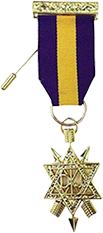
The Member's Jewel incorporates two interlaced gilt triangles, three arrows and the initials D and J.

The Prince of the Order wears the Jewel associated with the second Degree together with its distinctive ribbon and sash.
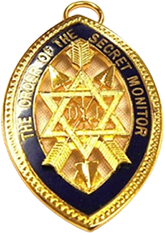
The Supreme Ruler wears the Jewel suspended from a collarette, together with the distinctive sash and violet robe of kingship.
The Order has a long and distinguished history in India. Its development began with individual Conclaves and eventually led to District Grand Conclaves and, in 2013, the establishment of a sovereign Grand Conclave in India.
Damon and Pythias Conclave No. 14, Madras, was the first Secret Monitor Conclave established in India.
The growth of the Order resulted in the formation of the District Grand Conclave of Southern India.
A sovereign Grand Conclave in India was constituted and consecrated in Chennai.
The first Secret Monitor Conclave in India was Damon and Pythias Conclave No. 14, Madras, established in 1889 through the efforts of Bro. Rev. C. H. Maiden.
The pioneering Conclave helped stimulate the establishment of further Conclaves. In 1926, a District Grand Conclave of Southern India was formed, with R. Wy. Bro. Sir Archibald Y. G. Campbell appointed as its first District Grand Supreme Ruler.
Over the following decades the Order developed across India. The Northern, Western, Southern and Eastern Districts each developed their own Conclave communities.
The Northern District became an important part of this development. Sundaram Conclave No. 110 consecrated on 30 June 1951 became the oldest Conclave in the District Grand Conclave of Northern India.
After more than 125 years of development under the Mother Grand Conclave, the four District Grand Supreme Rulers petitioned for a sovereign Grand Conclave in India.
The Grand Conclave in India has been guided by successive Grand Supreme Rulers since its constitution in 2013.
Grand Supreme Ruler
Grand Supreme Ruler
Grand Supreme Ruler
Grand Supreme Ruler
Chennai became the setting for the constitution and consecration of the sovereign Grand Conclave in India. The four District Grand Supreme Rulers had petitioned the Grand Supreme Ruler for the creation of an independent Grand Conclave, marking a significant milestone in the history of the Order in India.